Nepal’s PE/VC Comes of Age

First Choice Foods Pvt Ltd, based in Butwal, made history n June 2025 by exporting French fries to the United states–an unprecedented milestone for Nepal’s agri-processing sector. Buoyed by the breakthrough, the company is now preparing to enter the UK, Australian, and Japanese markets. Operating under the Himalayan Crisps brand, First Choice produces premium French fries and other potato-based products at its processing plant in Mainahiya, Rupandehi, serving both domestic and international customers. Its expansion has been supported by growth capital from Nepali private equity firm Avasar Equity.

A similar arc of scale and ambition is unfolding in technology. In October 2025, Fusemachines Inc. announced that its ticker had gone live on NASDAQ, becoming the first company founded by a Nepali-origin entrepreneur to be listed on the exchange. The listing marked a defining moment for Nepal’s IT sector, placing a Nepali-founded firm alongside global technology leaders. Fusemachines was backed at an early stage by Nepali private equity and venture capital firms Business Oxygen and Dolma Impact Fund, which helped it scale into a global enterprise AI company.

In consumer goods, Delish Diaries is reshaping Nepal’s dairy market with premium Greek yogurt made using traditional methods and high-quality ingredients. Revenues surged from Rs 90 million in fiscal year 2023/24 to Rs 220 million in FY 2024/25, enabling the company to break even and expand to three production plants. Its growth has been accelerated by Rs 115 million in Series A funding from NIBL Equity Partners. Likewise, Nepal’s leading food-delivery platform, Foodmandu, scaled nationally with backing from Nepali PE/VC firms True North Associates and Team Ventures.
Taken together, these trajectories mark a turning point. What once appeared episodic and externally driven is consolidating into a domestically anchored risk-capital ecosystem. In 2024, Nepal’s private equity and venture capital industry crossed a threshold that had been years in the making. For the first time, risk capital was no longer operating at the margins of the financial system; it was shaping it.

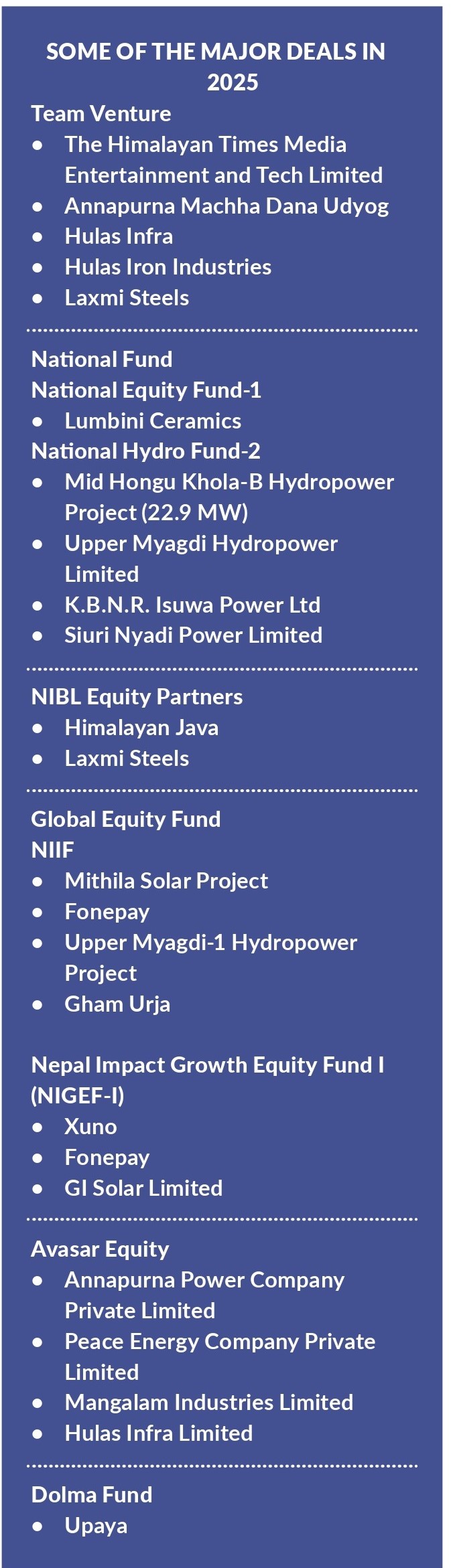
According to the Nepal Private Equity Association’s Market Intelligence Report, PE/VC funds invested $64 million in a single year—the highest annual deployment on record. That figure alone accounted for nearly 40% of all private equity and venture capital investment made in Nepal since 2012. Forty deals were closed during the year across nine active funds, three of which were deploying capital for the first time.

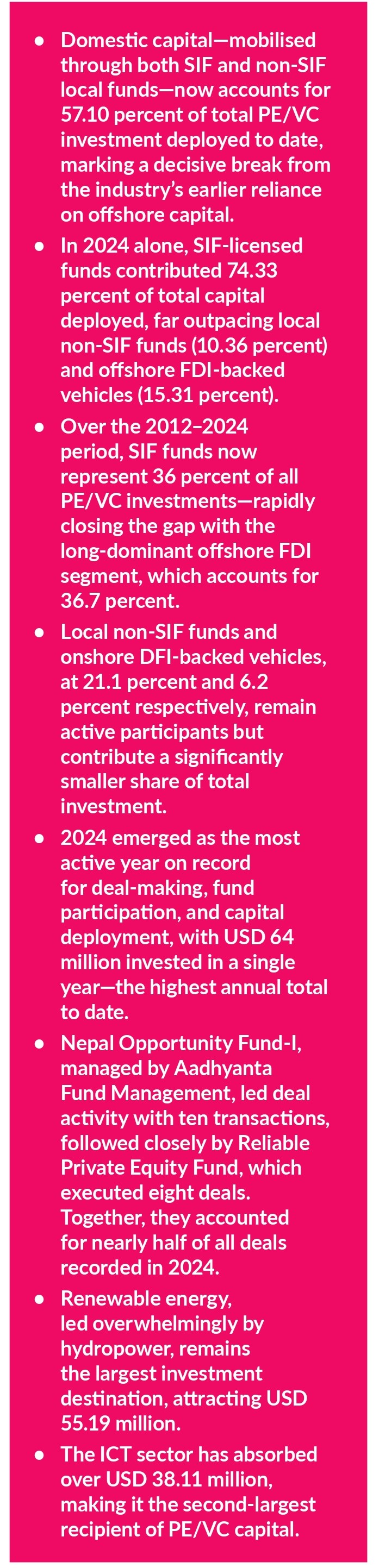
More telling than the volume, however, was the source. Over 74% of 2024 investments came from funds licensed under Nepal’s Specialized Investment Fund (SIF) framework. Across the 2012–2024 period, domestic capital—mobilized through both SIF and non-SIF local funds—now accounts for more than 57% of total PE/VC deployment. Risk capital, once largely imported through donor-led and offshore vehicles, is increasingly being generated—and recycled—at home.

This rebalancing carries implications far beyond deal counts. Nepal’s private equity and venture capital industry is emerging not as a substitute for banks, but as a structural complement to a bank-dominated financial system. In Nepal, access to bank credit is contingent on promoters first contributing substantial equity—yet for many entrepreneurs, mobilizing that equity has long been the binding constraint. Commercial banks do not finance ideas; they finance established enterprises with balance sheets, collateral, and predictable cash flows. Private equity fills the gap between concept and credit, providing the risk capital required to establish enterprises, meet debt–equity ratios, and ultimately make projects bankable.
In this sense, PE/VC does not displace banks; it enables them, expanding the universe of viable borrowers and investable projects. It signals a transformation in how capital is mobilized, how risk is shared, and how Nepali enterprises scale—moving the economy, at last, beyond an overwhelming dependence on banks, collateral, and personal guarantees.

Before the Labels Existed

Private equity did not arrive in Nepal with a regulatory framework or even a shared vocabulary. Long before the term entered policy documents, investment companies were already pooling capital, hiring professional managers, and taking stakes in businesses—particularly in energy  and trading.

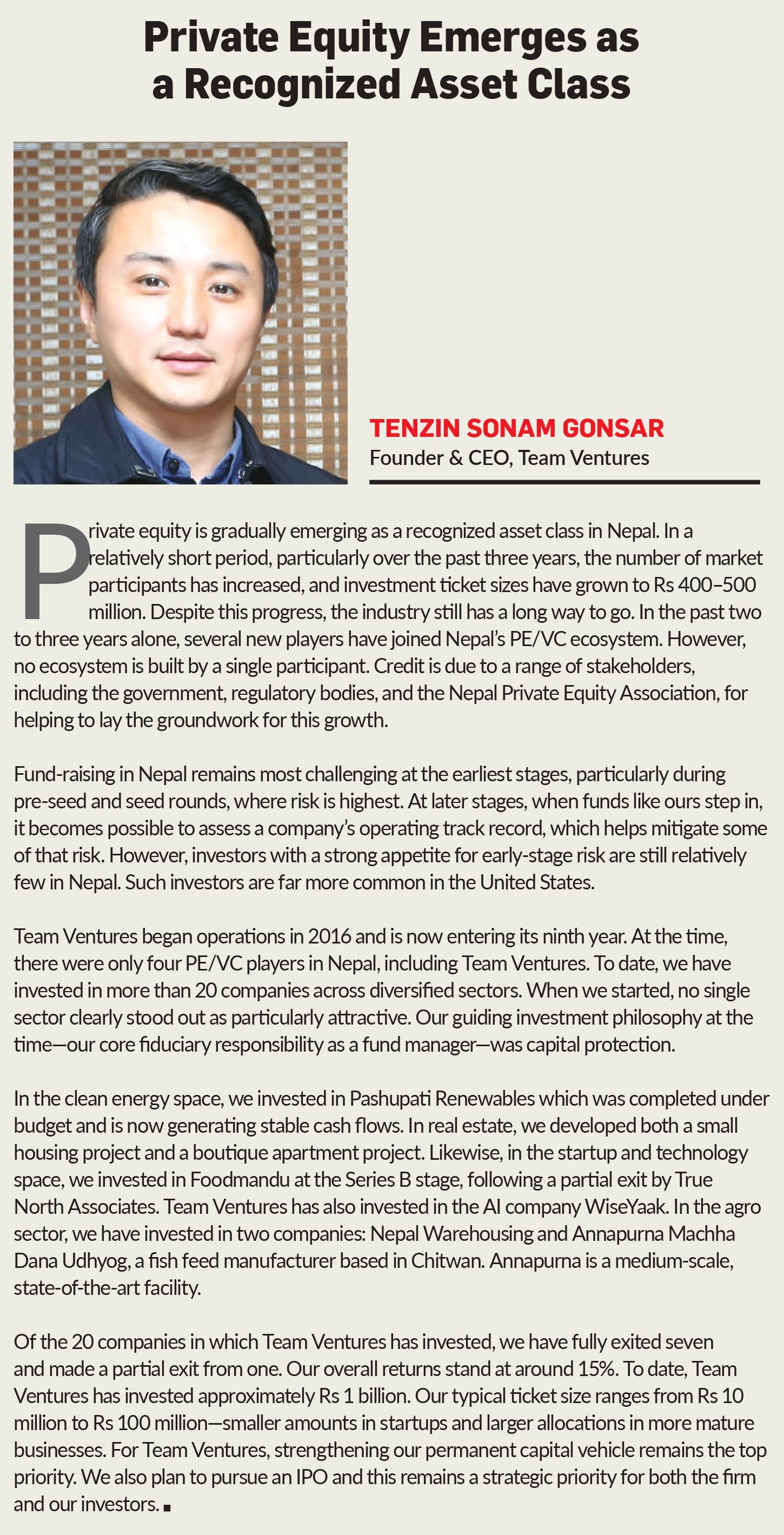
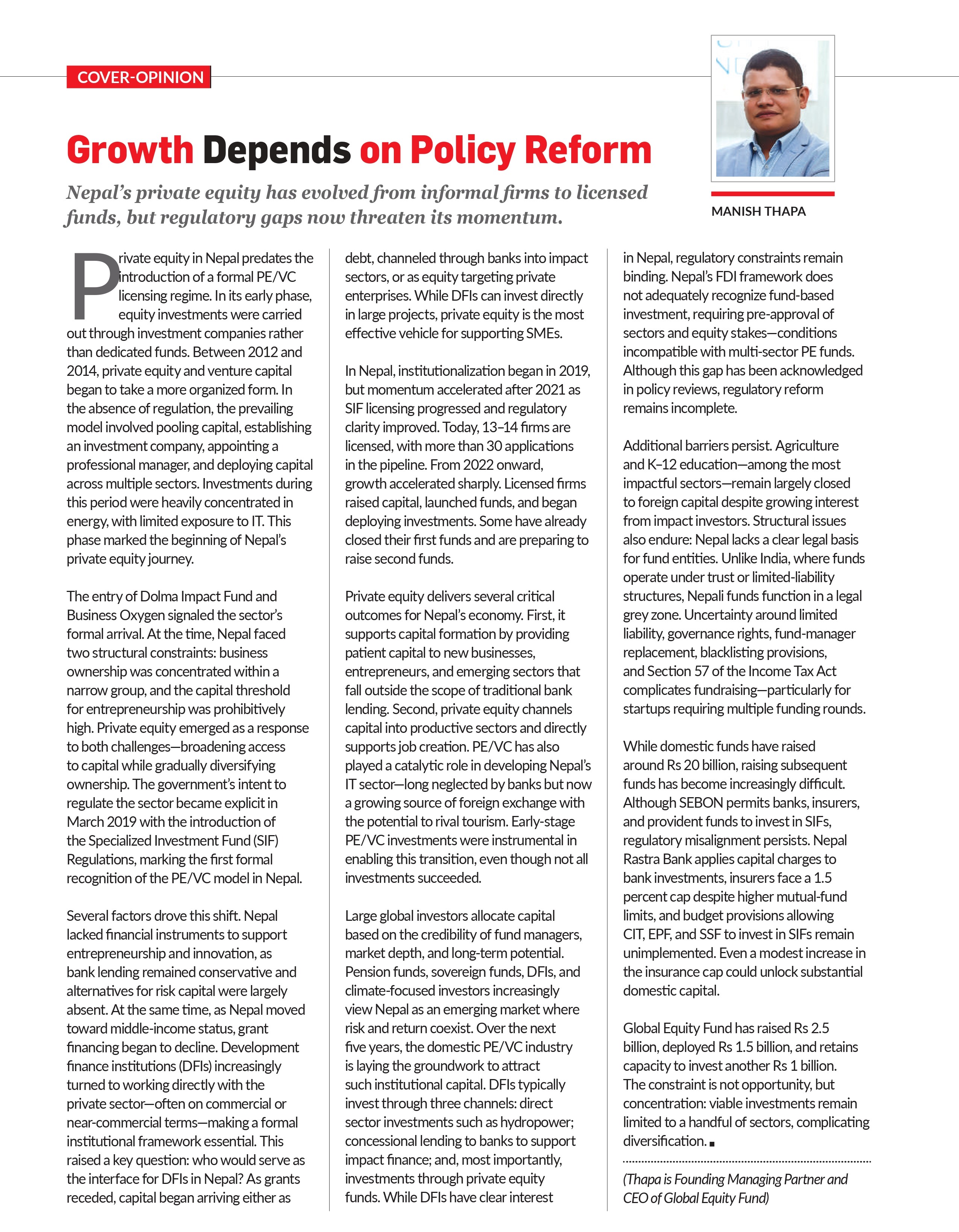
“If we look at the history of private equity in Nepal, before there was a formal PE/VC licensing regime, these activities  existed mainly through investment companies,” says Manish Thapa of Global Equity Fund. “From around 2012, private equity and venture capital began to take shape in a more organized manner, but there was no regulation.”
In that early phase, the model was rudimentary. Capital was pooled, an investment company was formed, and funds were deployed across multiple sectors. Most early investments flowed into hydropower, with limited exposure to information technology. Governance standards varied widely, shareholder protections were inconsistent, and exits were rare.

What was missing was not capital alone, but a philosophy of shared risk, structured governance, and long-term partnership. That conceptual break came with the arrival of two institutions: Business Oxygen and Dolma Impact Fund. Backed by international development partners, they introduced ideas that were largely unfamiliar to Nepal’s private sector—minority equity, structured shareholder agreements, ESG standards, and the principle that investors share losses as well as gains.

“When Dolma Fund and Business Oxygen entered the market, private equity formally arrived in Nepal,” Thapa says. “They didn’t just invest capital; they established the very concept of private equity.”
Their emergence coincided with broader global changes. The rise of private equity in Nepal also coincided with a deeper transition in development finance itself. As Nepal moved toward middle-income status, traditional grant-based aid began to decline, and development finance institutions increasingly shifted toward commercial and near-commercial engagement with the private sector. This raised a practical question: who would serve as the interface for DFIs seeking economy-wide impact? While banks absorbed concessional debt, private equity emerged as the natural vehicle for deploying long-term risk capital into SMEs, innovation, and emerging sectors.

In this sense, PE/VC was not merely a financial innovation, but an institutional response to the gradual unwinding of the aid era. This global rethinking accelerated after the 2008 financial crisis, as donor countries and development finance institutions reassessed the effectiveness of traditional aid.

“Development finance was no longer only about aid,” recalls Shabda Gyawali of Dolma Impact Fund. “It became about finding solutions where traditional aid had fallen short—solutions that were effective, sustainable, and scalable.”

Nepal, emerging from conflict and prolonged political transition, offered both risk and opportunity. Yet equity capital faced deep cultural resistance. Entrepreneurs understood debt. Banks demanded collateral and personal guarantees. Equity, by contrast, implied shared ownership, transparency, and external oversight. Convincing promoters that an investor could be a partner rather than a threat took time. External shocks—the 2015 earthquake, the blockade, and recurring political instability—further delayed momentum. Risk capital survived, but it remained niche.
From Aid to Equity

Dolma Impact Fund’s experience illustrates both the promise and the limits of Nepal’s early private equity experiment. Fundraising began in 2012, and by 2014 Dolma had raised $36.6 million from European development finance institutions. Yet its first investment came only in 2016.

“The private sector understood loans, not equity,” Gyawali explains. “The idea that an investor would share both profits and losses was unfamiliar.”

Dolma’s first hydropower investment merged two small projects into a single company, introducing scale, governance discipline, and institutional shareholder agreements. The transaction challenged prevailing banking norms by demonstrating that institutional investors do not require personal guarantees.

Not all early investments succeeded. The e-commerce platform  Sastodeal eventually failed, and the investment was written off. Yet even that failure mattered.

“It showed what early-stage risk looks like,” Gyawali says. “You don’t build ecosystems without failures.”
Private equity also introduced ESG standards to Nepal’s corporate landscape. For DFI-backed and impact-oriented funds, private equity is not only about deploying capital but about embedding resilience and governance into enterprise growth. Impact, in this context, is deliberate rather than incidental. Fund managers increasingly integrate ESG standards, gender inclusion, and climate-risk assessments into investment decisions,  while working with portfolio  companies on issues such as insurance coverage, operational resilience, and adaptation to climate shocks. This approach reflects a recognition that SMEs—often celebrated for job creation—are also among the most vulnerable to environmental and economic disruptions. Strengthening resilience at this level is not ancillary to returns; it is integral to sustainability.

At the transaction level, projects were assessed not only for financial returns but for governance quality, environmental compliance, and social impact. Flexible capital structures—convertible equity and preferred shares—began to appear where traditional bank financing was unavailable.

Despite these innovations, the ecosystem remained constrained by the absence of a domestic regulatory framework. Funds were structured offshore, and foreign investment rules did not recognize pooled fund vehicles operating within Nepal.

The SIF Turning Point

That changed in 2019, when Nepal introduced the Specialized Investment Fund Regulations. For the first time, private equity and venture capital were explicitly recognized within the country’s financial architecture.

“When the government introduced the SIF Regulations, it sent a clear signal that PE/VC had been formally accepted,” says Thapa. “That recognition mattered as much as the capital.”
Initial uptake was cautious. Global Equity Fund was the first to apply. Regulators hesitated, unsure how to supervise a new asset class. Merchant banks raised questions about role overlap and regulatory boundaries. Clarity emerged gradually. By 2021–22, the first licenses were issued. Lock-in provisions were clarified. Institutional investors began to engage. Momentum accelerated.

“After 2022, the number of funds, the size of their funds, and the volume of investments increased sharply,” Thapa says. “Today, Nepal’s domestic private equity market has raised around NPR 20 billion.”

A quieter but equally consequential shift is now visible beneath these headline figures. Nepali PE/VC fund managers are no longer focused solely on launching and deploying their first funds; several are actively preparing successor vehicles. Early SIF-licensed funds have moved beyond proof of concept to portfolio construction, disciplined deployment, and initial exits—bringing questions of continuity, track record, and institutional credibility to the fore. As Thapa observes, some domestic funds have already closed or are nearing the end of their first investment cycles, while others are confronting the harder task of raising second and third funds amid capital concentration, regulatory friction, and limited institutional participation. Dhruba Timilsina similarly notes that most SIF fund managers are now in transition—from deploying inaugural capital to building durable fund platforms capable of attracting repeat commitments. This evolution marks a structural turning point: Nepal’s PE/VC ecosystem is no longer defined by one-off funds, but by the emergence of managers seeking permanence, scale, and credibility across fund generations.

The speed of the transition has been striking. Between 2012 and 2024, SIF-licensed funds accounted for roughly 36% of all PE/VC investment in Nepal—nearly matching offshore FDI-backed funds, which took more than a decade to build their presence.

In 2024 alone, SIF funds dominated capital deployment, accounting for nearly three-quarters of all investment.
2024: The Breakout Year

The NPEA data makes clear that 2024 was not simply another incremental year. It marked  a qualitative shift in scale, confidence, and participation.

Forty deals were closed during the year, the highest annual figure on record.  Nine funds were active, including three new entrants deploying capital for the first time. Nepal Opportunity Fund–I and Reliable Private Equity Fund together accounted for nearly half of all transactions, underscoring the emergence of anchor investors capable of driving deal flow.

“The growth we’re seeing reflects regulatory clarity and institutional participation,” says Timilsina of Avasar Equity. “Bank credit alone cannot finance growth.”

Ticket sizes have increased significantly. Investments of Rs 200–500 million are now common  in growth-stage companies and infrastructure-linked sectors. Capital is flowing into hydropower, solar energy, manufacturing, hospitality, information technology, and agro-processing.

The growing concentration of private equity capital in hydropower, solar energy,  and hospitality reflects less a failure of imagination than a constraint of market structure. In an economy where secondary markets remain thin and IPOs constitute the primary exit pathway, capital naturally gravitates toward sectors with listing visibility, regulatory clarity, and scale. Smaller SMEs and innovation-driven firms often lack viable exit routes, making them difficult to support at larger ticket sizes without secondary markets. Until Nepal’s capital markets deepen and alternative exit mechanisms emerge, this sectoral skew is not an aberration—but a rational  response to exit economics.

This pattern is borne  out by the data. Sectoral data from the NPEA shows  renewable energy—particularly hydropower—absorbing the largest share of capital, followed by ICT, manufacturing, and hospitality.

Capital with Structure

As capital volumes have grown, so too has the sophistication of investment structures. While common equity remains dominant, hybrid instruments are increasingly used to balance risk, returns, and promoter incentives.

“In early-stage and small-cap investments, assigning high valuations can be challenging,” says Timilsina. “But deploying large amounts of capital at low valuations can result in excessive dilution. Blended  structures help align interests.”

Internationally, private equity funds  routinely deploy a mix of equity, quasi-equity, and structured private credit, tailoring instruments to enterprise maturity and cash-flow profiles. In Nepal, however, regulatory frameworks still largely restrict funds  to common equity and preference shares.

“The policy framework is evolving, but refinement is needed,” Timilsina says. “Greater alignment with international practice would significantly improve  operational feasibility.”

Fund lifecycles present another challenge.  SIF regulations require  capital to be raised and deployed within relatively compressed timelines, while global closed-end private equity funds typically operate over ten years, with staged drawdowns and defined  investment periods.  In practice, capital is not deployed on day one; it is called as investment opportunities mature.

Taxation remains  a further point of friction. The absence of a clear pass-through mechanism means income can be taxed at both the fund and investor levels, creating distortions—particularly for tax-exempt institutional investors. These structural frictions  do not halt activity, but they raise costs and constrain flexibility as funds scale.

The Risk Gap

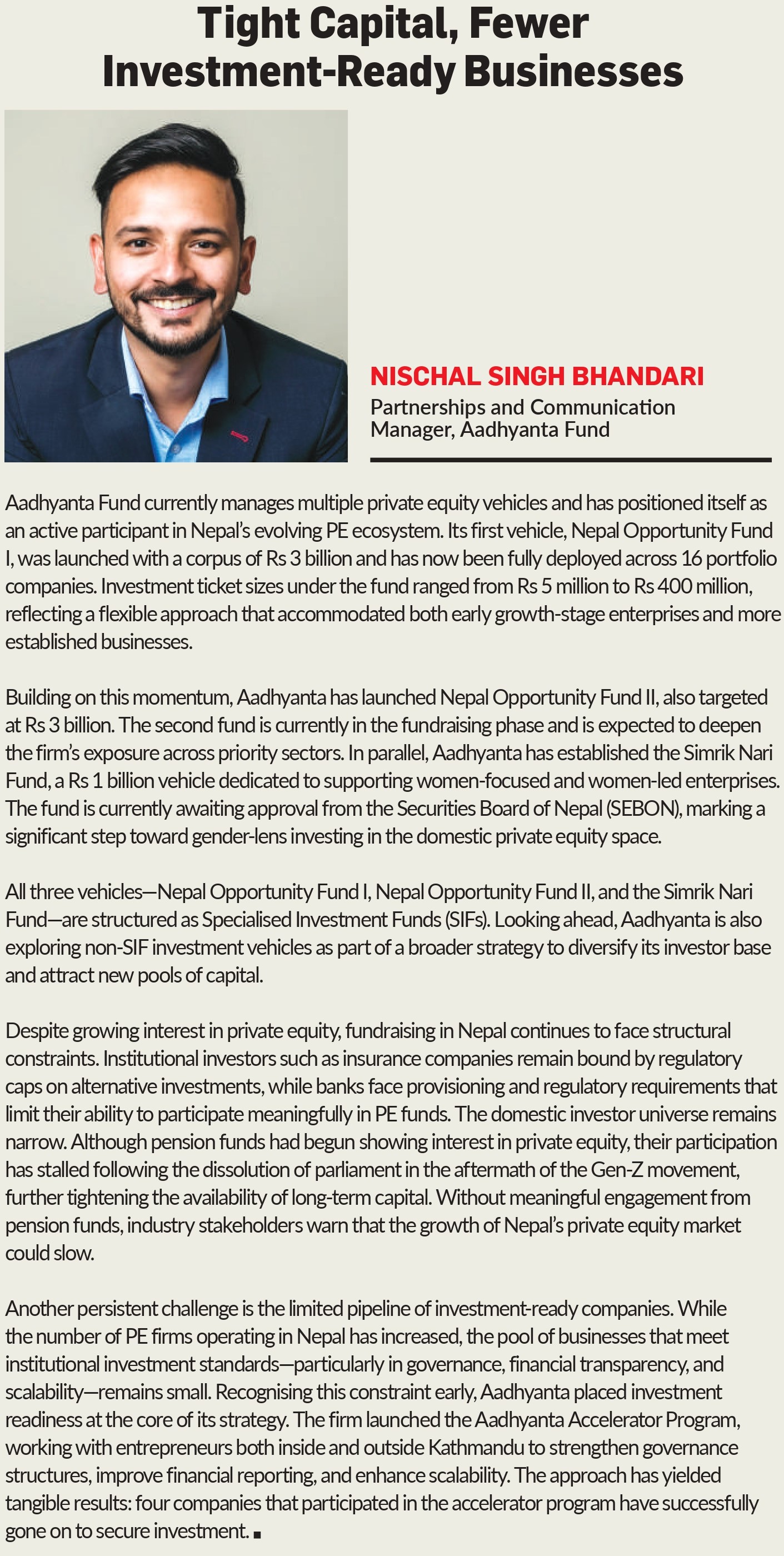
Despite record investment levels, Nepal’s PE/VC ecosystem continues to struggle at the earliest stages of enterprise development. “The highest risk lies at the pre-seed and seed stages,” says Sonam Tenzin of Team Ventures. “In Nepal, investors willing to take that risk are still relatively few.”

Founded in 2016, Team Ventures has invested in more than 20 companies across sectors ranging from solar energy and real estate to food delivery, artificial intelligence, and agro-processing. It has exited seven investments and achieved overall returns of around 15%.

“When we started, capital protection was our primary concern,” Tenzin says. “Now we see funds expanding into manufacturing and hospitality, which reflects a maturing market.”

Yet early-stage innovation remains  underfunded. Unlike mature startup ecosystems, Nepal lacks both a broad cultural acceptance of failure and policy instruments—such as first-loss capital or co-investment facilities—that can absorb early risk. As funds grow larger, they naturally gravitate toward later-stage, asset-backed opportunities with clearer exit visibility, leaving a persistent financing gap at the innovation end of the spectrum.

Policy Meets Scale

As private equity scales, tensions with existing policy frameworks are becoming more pronounced. Larger funds increasingly gravitate toward hydropower, solar, and five-star hotels—sectors with  visible IPO exit pathways. SMEs and impact-driven ventures risk being sidelined.

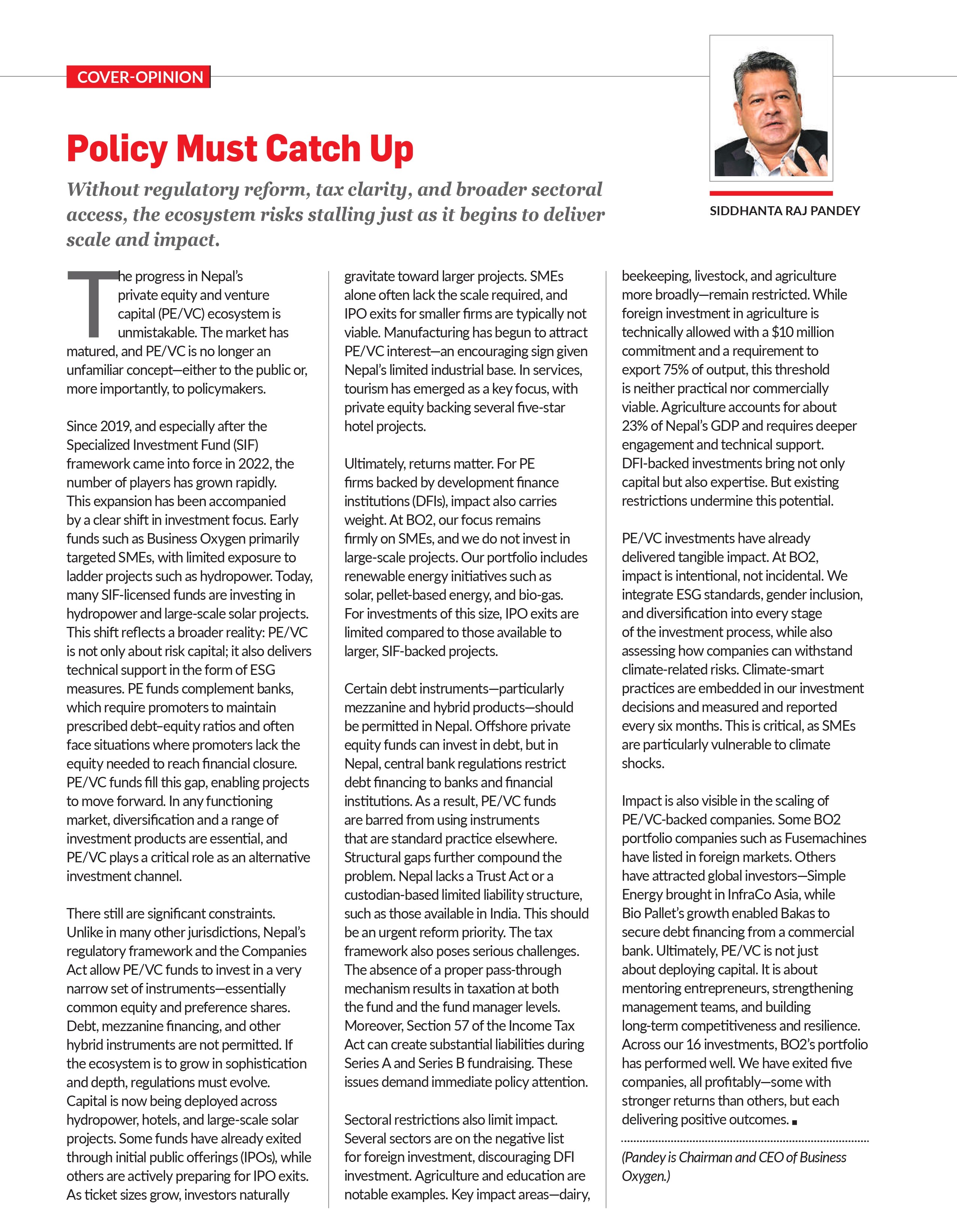
“Private equity is not only about risk capital,” says Siddhanta Raj Pandey of Business Oxygen. “It also provides technical support, ESG integration, and helps projects meet bankability requirements.”

Pandey argues that Nepal’s regulatory framework has not kept pace with market realities. Debt, mezzanine finance, and hybrid debt instruments are not yet permissible under  existing rules. Foreign investment restrictions continue to limit development finance  institution participation in agriculture and education—sectors with the greatest development impact.
“These restrictions undermine the very objectives policymakers claim to support,” Pandey says. “The ecosystem has grown up. Now policy must catch up.”

Tax policy presents similar challenges. The absence of pass-through taxation and the application of Section  57 of the Income Tax Act complicate fundraising and follow-on investments, particularly  during Series A and Series B rounds. For growth-stage companies, this creates friction precisely  when  additional capital is needed to scale.

Exits and the Next Phase

Exits remain the ultimate test of any private equity ecosystem. In Nepal, IPOs and promoter buybacks dominate. Secondary markets are thin, and liquidity constraints persist.

“Ultimately, fund managers are judged  by exits,” says Gyawali of Dolma Impact Fund. “Returns define track records.”

As more PE-backed companies approach listing, Nepal’s capital markets will face new pressures. For larger firms, domestic liquidity may prove insufficient, raising the question of dual listings and cross-border exits.

“Some companies are simply too large for Nepal’s market,” Gyawali notes. “Policy needs to anticipate that reality.”

Market participants argue that enabling dual listings would not only expand exit options but also improve valuation  discovery  and international visibility. Others suggest that permitting Nepali PE funds to invest abroad—mirroring Indian practice—could attract foreign  limited partners by diversifying risk and returns.

What Needs  to Change in the SIF Regime

The rapid rise of SIF-licensed private equity and venture capital funds has exposed a paradox at the heart of Nepal’s regulatory framework. The very regulations that unlocked domestic capital mobilization  are now increasingly cited as constraints on the ecosystem’s next phase of growth.

At its core, the challenge is not regulatory hostility but regulatory incompleteness. The SIF framework was designed when Nepal’s PE/VC ecosystem was small, experimental, and largely donor-driven. It has since evolved into a market with cumulative investment of $174 million by end-2024, rising ticket sizes, and growing institutional participation.

Yet many underlying  assumptions embedded in the regulation remain anchored in an earlier phase.

One persistent concern relates to the legal structure of funds. Under Nepal’s current framework, SIFs are typically established as companies. “In most global markets, funds are structured under trust frameworks or as limited-liability partnerships,” says Thapa of Global Equity Fund. “Investors expect their liability to be limited strictly to their capital commitment. In Nepal, that clarity does not yet exist.”

This absence of a dedicated trust law or custodian-based fund structure directly affects foreign limited partner participation, particularly  for development finance institutions, pension funds, and sovereign investors whose mandates require strict legal certainty. Without explicit limitation of liability, Nepal struggles to compete with regional fund domiciles.

Equally significant is the restricted menu of permissible investment instruments. International private equity routinely deploys equity, preferred equity, convertibles, and structured private credit. Nepal’s regulatory framework remains narrowly focused on common equity and preference shares.

“Private equity is not only about buying ordinary shares,” says Timilsina. “International practice demonstrates  the use of equity, quasi-equity, and structured instruments depending on risk profile and stage. Our framework needs to recognize that.”

The absence of regulatory clarity around fund-based private credit creates further ambiguity. While Nepal Rastra Bank appropriately regulates deposit-taking institutions, private credit extended by closed-end investment funds is fundamentally different from bank lending. Treating  both under the same conceptual umbrella limits innovation and discourages instruments that could better align investor protection with enterprise growth.

Fund lifecycle alignment presents another constraint. Globally, closed-end private equity funds operate on ten-year horizons, with capital commitments drawn down gradually over three to four years. Under Nepal’s SIF regulations, funds  face pressure to raise and deploy capital within compressed timelines, creating unnecessary operational strain.

Liquidation mechanisms pose similar challenges. Investments in unlisted companies are inherently illiquid, and exits do not always materialize neatly within a predefined timeframe. International practice recognizes in-specie distributions, where investors receive  proportional ownership in portfolio  companies if cash exits are not feasible at fund maturity. Nepal’s regulatory framework does not explicitly recognize such mechanisms, creating uncertainty at the end of a fund’s life.

Taxation remains  another fault line. The absence of a clear tax pass-through mechanism means income may be taxed at both the fund and investor levels, even when investors themselves are tax-exempt.

“Without pass-through treatment, distortions arise,” Timilsina says. “Tax-exempt investors can end up indirectly bearing tax through the fund structure, undermining neutrality.”

These distortions are compounded by provisions  such as Section  57 of the Income Tax Act, which can trigger tax liabilities during follow-on  fundraising rounds. For growth-stage companies, this creates friction precisely  when  additional capital is required to scale.

Sectoral restrictions on foreign  investment further complicate matters. Several impact-critical sectors, including agriculture and parts of education, remain on Nepal’s negative list for foreign investment. While domestic funds can invest, foreign limited partner participation is indirectly discouraged.

“Most DFIs are eager to invest in agriculture and education because that’s where impact is greatest,” Thapa says. “If investments are managed by Nepali fund managers, these restrictions should be reconsidered.”

Pandey echoes this view, arguing that current thresholds for foreign participation in agriculture are commercially unrealistic. “Agriculture contributes about 23% of Nepal’s GDP,” he says. “Yet foreign investment is effectively blocked  by conditions that don’t reflect market realities. This undermines both impact and growth.”

The cumulative effect is not stagnation but friction. Funds continue to raise capital, deploy investments, and prepare successor vehicles. But without regulatory refinement, Nepal risks capping the ecosystem’s potential just as it begins to deliver scale.

Foreign LPs and the Next Phase of Growth

As Nepal’s private equity market matures, its future trajectory will increasingly depend on two interlinked factors: the ability to attract foreign  limited partners and the availability of credible exit pathways. But scale will hinge just as critically on domestic institutions. The next phase of Nepal’s private equity evolution may depend less on entrepreneurial appetite than on institutional participation. Although budget speeches have repeatedly permitted banks, insurers,  and statutory funds such as the EPF,

CIT, and SSF to allocate a portion of their portfolios to SIFs, regulatory misalignment has limited actual deployment. Capital charges on bank investments, conservative exposure caps for insurers, and the absence of clear implementation guidelines  have kept vast pools of long-term domestic capital on the sidelines. Even modest adjustments—such as raising insurance exposure limits or operationalizing existing budget provisions—could mobilize hundreds of billions of rupees, transforming private equity from a niche asset class into a systemic pillar of capital formation.

Historically, development finance  institutions were the primary source of foreign capital in Nepal’s PE/VC ecosystem. Funds such as Dolma Impact Fund demonstrated that DFI participation could crowd in local capital, introduce governance standards, and absorb early risk. As domestic SIF funds now dominate deal flow, the question has shifted  from whether foreign capital is necessary to how it can be integrated without distorting the market.

“DFIs have both an interest in Nepal and a mandate to invest here,” Thapa says. “But Nepal’s FDI regulations were not designed with fund-based investment structures in mind.”

Under current rules, foreign investors are typically required to pre-declare sector, investment amount, and ownership structure—requirements that run counter to the pooled-fund model, where capital is allocated dynamically across  sectors over time. While the SIF framework has opened the door in principle, operational clarity remains limited.

Exits remain the defining test. IPOs and promoter buybacks continue to dominate, steering PE capital toward IPO-ready sectors such as hydropower, solar, hotels, and manufacturing. Smaller SMEs and innovation-driven firms, where IPOs are less viable, struggle to attract later-stage capital.

A Market That Can No Longer Wait

Nepal’s private equity and venture capital ecosystem has crossed the point at which it can be treated as an experiment. With domestic funds now driving the bulk of capital deployment, private equity has moved from the margins of the financial system to its core.

That shift brings responsibility. The rise of SIF-licensed funds has demonstrated how regulatory clarity can unlock capital at scale. At the same time, it has exposed the limits of incomplete reform. Legal uncertainty around fund structures, restrictions on investment instruments, unresolved tax treatment, and sectoral barriers to foreign participation are no longer abstract policy issues. They have become binding constraints on a market that is already deploying  significant capital and preparing for its next phase.

The risk today is not collapse, but stagnation. Without timely reform, Nepal’s private equity ecosystem could become locked into a narrow corridor—dominated by IPO-ready, asset-heavy projects—while innovation-led firms, early-stage ventures, and impact sectors remain chronically underfunded.

Private equity was introduced in Nepal to address a structural gap: the absence of long-term risk capital in an economy overly dependent on banks, collateral, and short-term credit. That gap has not closed; it has evolved. As funds scale and ticket sizes increase, the central question is no longer whether private equity can mobilize capital, but whether policy can accommodate complexity.

The coming decade will be decisive. If Nepal aligns its regulatory framework with global fund practices—by clarifying fund entity structures, broadening permissible instruments, adopting tax pass-through principles, and reopening critical impact sectors to foreign participation—it can entrench private equity as a durable pillar of economic transformation. If it does not, the market will still grow, but unevenly,  leaving much of its developmental promise unrealized.

Private equity in Nepal has learned to take risk. The test now is whether the state is willing to do the same.

(This was the cover story of January 2026 issue of New Business Age magazine.)

Source: https://www.newbusinessage.com/news/46914/nepals-pe-vc-comes-of-age/

आर्थिक अभियान १९औं वार्षिकोत्सव विशेष : जलवायु अनुकूलन हरित अर्थतन्त्रका लागि वित्तीय लगानी

जलवायु परिवर्तनबाट हुने र भइरहेको जोखिम कम गर्दै जलवायु न्यूनीकरण, अनुकूलन तथा प्रतिरोधका साथै दिगो अर्थतन्त्र निर्माणका लागि गरिने वित्तीय लगानीलाई ‘क्लाइमेट फाइनान्स’ अर्थात जलवायु वित्तका रूपमा परिभाषित गरिएको छ । मुख्य गरी जलवायु परिवर्तन न्यूनीकरण वा अनुकूलनसम्बन्धी योजना तथा कार्यक्रम कार्यान्वयनका लागि आन्तरिक तथा बाह्य स्रोतबाट उपलब्ध गराइने आर्थिक स्रोतलाई जलवायु वित्त भनिन्छ । अन्तरराष्ट्रिय विकास साझेदार संस्थाहरूको अनुदान तथा सहुलियत कर्जाका रूपमा शुरू भएको लगानीको अवधारणा विस्तारै बैंक, वित्तीय संस्थाको व्यावसायीक ऋणमा पनि जोडिन थालेको छ । जसले गर्दा बैंक, वित्तीय संस्थाले ऋण लगानी गर्दा पनि कार्बन उत्सर्जन कम गर्ने परियोजनालाई प्राथमिकता दिनुपर्छ भन्ने अवधारणा व्यापक बन्दै गएको छ ।

‘क्लाइमेट फाइनान्स’को मुख्य उद्देश्य कार्बन उत्सर्जन कम गर्दै शून्य बनाउनु नै हो । कार्बन उत्सर्जन कम गर्न वित्तीय क्षेत्रको लगानी पनि नवीकरणीय र हरित ऊर्जामा बढाउनुपर्छ । घरायसी कामदेखि उद्योग कलकारखानामा कार्बन उत्सर्जन गर्ने उपकरणको प्रयोग कम गर्दै विद्युतीय उपकरणलाई प्राथमिकता दिनुपर्छ । यस्तै कम ऊर्जा खपत गर्ने उपकरण प्रयोगमा जोड दिनुपर्छ । वित्तीय संस्थाहरूले पनि ऋण प्रवाह गर्दा हरित उद्योगलाई प्राथमिकता दिनुपर्छ ।

यसको अर्को पक्ष भनेको कार्बन उत्सर्जन शून्य बनाउन नसक्दासम्म यसको प्रभाव कम गर्ने वा यसले पार्ने नकारात्मक प्रभावबाट बचाउन काम गर्ने पनि हो । जलवायु परिवर्तनले पार्ने असरको मूल्यांकन गर्दै त्यसका लागि आवश्यक तयारी पनि गर्नुपर्छ । जलवायु परिवर्तको असर पर्नेलाई अग्रिम तयारी गराउनुपर्छ । जस्तै कुनै बेला समुद्री सतहबाट ६–७ सय मीटरमा उत्पादन हुने बालीनाली जलवायु परिवर्तनजन्य तापक्रम वृद्धिले अहिले ८–९ सय मीटरमा मात्र उत्पादन हुने अवस्था बनेको छ भने त्यसका लागि हाम्रा किसानलाई आवश्यक जानकारी दिएर तयार बनाउन सकिन्छ । हिजो तल्लो तहमा फल्ने बाली अहिले माथिल्लो तहमा पनि फल्न थालेका छन् । यसको जानकारी हाम्रा किसानलाई हुने हो भने उनीहरूले खेती गर्ने जमीन परिवर्तन गर्न पाउँछन् । उनीहरूले जलवायु अनुकूलन हुने किसिमले खेती गर्न सक्छन् ।

यसैगरी जलवायु परिवर्तनबाट हुने जोखिम न्यूनीकरणका लागि अर्को पक्ष भनेको ‘क्लाइमेट इन्स्योरेन्स’ पनि हो । जलवायु परिवर्तनको असरले गर्ने क्षतिको बीमा भएको छ भने जोखिम वहन गर्ने क्षमता बढ्छ । अहिले जलवायु परिवर्तनको जोखिममा पनि सबैभन्दा बढी गरीब छन् । हालै थामेमा गएको बाढीले ठूलो क्षति भयो तर त्यहाँ इन्स्योरेन्स भएको थिएन होला ।

बिजनेश अक्सिजनले क्लाइमेट फन्डका रूपमा काम गरिरहेको छ । हाम्रा धेरै प्रडक्ट जलवायु न्यूनीकरण, अनुकूलन तथा प्रतिरोधी हुने गरी डिजाइन गरिएका छन् । हामीले सौर्य ऊर्जामा लगानी गरेका छौं । सौर्य प्लान्टमार्फत पानी तान्ने पम्प सञ्चालन गरी सुक्खा ठाउँमा पनि खेतीपाती गर्न सकिने व्यवस्था गरेका छौं । यसले गाउँलेहरूलाई जलवायु परिवर्तन असरको प्रभाव कम परेको छ । जहाँ पानी नपर्दा पनि समस्या हुँदैन । यस्तै हामीले सर्लाही जिल्लामा जंगलको झारपात संकलन गरी बायोप्लान्ट बनाउने कारखानामा लगानी गरेका छौं । तर, अहिलेसम्म नेपाल सरकारले बायोग्यासलाई प्राथमिकता दिएको छैन । जबसम्म सरकारले पेट्रोलियम पदार्थ, रासायनिक मलमा अनुदान दिन्छ बायोग्यास, बायोमलमा प्रतिफल लिन सकिँदैन । प्रतिफल नआउने भएपछि यस क्षेत्रमा लगानी आउन पनि गार्‍हो हुन्छ ।

सरकारले सन् २०४५ सम्ममा कार्बन उत्सर्जन शून्यमा झार्ने लक्ष्य राखेको छ । त्यो लक्ष्य प्राप्त गर्न आजैदेखि काम शुरू गर्नुपर्ने हो । अहिले कार्बन उत्सर्जनमा नेपालको अंश शून्य दशमलव शून्य ३ प्रतिशत छ । यसलाई घटाउँदै शून्यमा झार्न ऊर्जा उत्पादन बढाउनुका साथै यसको खपतमा पनि जोड दिनुपर्छ । विद्युत् खपत बढाउन विद्युतीय गाडी, स्टोभ प्रयोगमा प्रोत्साहन गर्न आवश्यक छ ।

नेपालमा सन् १९६८ देखि नवीकरणीय ऊर्जामा वित्तीय क्षेत्रको लगानी शुरू भएको देखिन्छ । सरकारी स्वामित्वको कृषि विकास बैंकले ग्रामीण ऊर्जा प्रविधिहरू जस्तै सुधारिएको पानीमिल र बायोग्यासलाई ऋण उपलब्ध गराउन थालेको थियो । बायोग्यास त नेपालको सफलताको कथा नै हो । वैकल्पिक ऊर्जा प्रवर्द्धन केन्द्र स्थापनासँगै ग्रामीण क्षेत्रमा अनुदानमा सौर्यऊर्जा कार्यक्रम सञ्चालनमा आउन थालेका हुन् ।

दाताहरूको सहयोगमा सन् २०१५ को आसपास नेपालमा सार्वजनिक–निजी साझेदारी (पीपीपी) मोडेलको रूपमा निजीक्षेत्रका बैंकहरूसँग साझेदारी गरी केन्द्रीय नवीकरणीय ऊर्जा कोष स्थापना भएको पाइन्छ । यसमा अहिले हामीसँग सीमित संस्थागत ज्ञान मात्र छ । अब ग्रामीण ऊर्जा प्रविधिहरूलाई प्रोत्साहन गर्न अनुदानसहितको वित्तीय लगानी बढाउनुपर्ने आवश्यकता छ । सन् २०४५ सम्ममा शून्य कार्बन उत्सर्जनको लक्ष्य प्राप्त गर्न ४६ अर्ब डलर लगानी आवश्यक पर्छ । यो निजीक्षेत्रको सहभागितामा सरकार, विकास साझेदारका लागि सबै सरोकारवालाको सहकार्यमा मात्र सम्भव छ ।

ग्रिन फाइनान्सिङका लागि ठूलो लगानी आवश्यक छ । यसका लागि वैकल्पिक लगानीको स्रोत जुटाउन अब ‘ब्लेन्डेड फाइनासिङ’, ‘भायबिलिटी ग्याप फन्डिङ’ ‘ग्रिन बन्ड’, च्यालेन्ज फन्डजस्ता वित्तीय उपकरण पनि आवश्यक छ । यसको लगानीमा आजको भोलि प्रतिफल आउँदैन । यसमा धैर्य आवश्यक हुन्छ । निश्चित प्रतिफल ग्यारेन्टी भएको यस्ता वित्तीय उपकरणमा लगानी ल्याउन सार्वभौम रेटिङ पनि आवश्यक छ । किनकि विदेशीले ग्रिन बन्डमा लगानी गर्न खोज्छ । यसका लागि सरकार अघि बढ्नुपर्छ । अहिले नेपालमा जलविद्युत् क्षेत्रमा ठूलो सफलता देखिएको छ । पीपीपी मोडलमा काम भइरहेको छ । तर, सौर्यऊर्जामा भने कम मार्जिन छ । पीपीए घटाइरहेको छ । भारतमा सोलार ऊर्जा उत्पादकलाई धेरै सुविधा छ । सरकारले नै जग्गा सहुलियत दरमा उपलब्ध गराउँछ । नेपालमा त्यस्तो सुविधा छैन । सोलार प्रोजेक्ट गर्न ठूलोठूलो जग्गाको प्लट आवश्यक हुन्छ । हामीकहाँ सोलार ऊर्जाको पीपीएको प्रावधानमा पनि कडाइ छ । विगतमा विश्व बैंक र एशियाली विकास बैंकले सोलार आयोजनामा भायबिलिटी ग्याप फन्डिङ शुरू गरेको थियो । उसले गरेका पाँचओटा आयोजनामध्ये चारओटा त असफल नै भए ।

भारतले ४० हजार मेगावाट सौर्य ऊर्जा निकाल्ने घोषणा गरेको छ । हामीकहाँ अझै पेट्रोलियम पदार्थको आयात घटाउन सकेका छैनौं । बरु गाउँगाउँमा बाटो पुगेपछि एलपी ग्यासले बायोमासलाई विस्थापित गरेको छ, जसले गर्दा हाम्रो उल्टो विकास भइरहेको छ । गाउँगाउँमा विद्युत् पुगेर मात्र हुँदैन । यसको वितरणको व्यवस्था पनि राम्रो हुनुपर्छ । यदि तपाईंले खाना पकाउने समयमा बत्ती गयो भने के गर्ने भन्ने अवस्था छ । यस्तै गाउँघरमा इन्डक्सन बिग्रियो भने बनाउन सदरमुकाम नै आउनुपर्ने बाध्यता छ । यो अवस्थामा नवीकरणीय ऊर्जाको प्रयोगमा सर्वसाधारण आकर्षित हुन सकेका छैनन् ।

बिजुलीको उत्पादन बढ्दै जाँदा माग पनि वृद्धि हुनुपर्ने देखिन्छ । यसले बजारलाई पेट्रोलियम पदार्थको प्रयोगबाट सफा ऊर्जाको प्रयोग जस्तै विद्युतीय सवारीसाधन, चार्जिङ स्टेशन र बिजुलीबाट सञ्चालित खाना पकाउने, तताउने, कुलिङ, कृषि र औद्योगिक क्षेत्रहरूमा बढाउन सक्नुपर्छ ।

हालै राष्ट्र बैंकले ग्रिन ट्याक्सनोमी कार्यान्वयन गर्ने घोषणा गरेको छ । यो कसरी अघि बढ्छ अझै स्पष्ट छैन । मुख्य कुरा भनेको डिजेलबाट चल्ने उद्योगलाई सोलार ऊर्जामा परिवर्तन गर्न सहुलियत र कर छूटजस्ता प्रावधान आवश्यक छ । अहिले पनि बैंकहरूले लगानी गर्दा वातावरणीय, सामाजिक तथा संस्थागत सुशासनको सूचकहरूको पालना हुनुपर्छ । अहिले यसको पालनाको अवस्था कस्तो छ भन्न सकिँदैन । तर, कुनै पनि व्यक्ति वा संस्थाले गर्ने लगानीमा दिगोपना हुन आर्थिक रूपमा फाइदा हुनुपर्छ, नत्र उसले किन लगानी गर्ने भन्ने हुन्छ ।


श्रोत: आर्थिक अभियान


BO2 FEATURED IN THE FINANCIAL TIMES 100+ IMPACT INVESTORS LIST

We are honored to announce that in collaboration with the GIIN, the Financial Times has just published a list of 100+ impact investors, including Business Oxygen Pvt. Ltd. (BO2). This searchable list highlights our impact assets under management and our strategic focus across key sectors and global regions. This initiative marks a significant milestone for impact investing, providing a useful resource for investors to align their portfolios with impactful and sustainable solutions. With the Financial Times as the list’s platform, we are marking an important milestone for impact investing as a tool to tackle the world’s most pressing problems. This list is a guide for investors, showcasing where capital is making a difference and inspiring future investments. By contributing our data, we’re advancing transparency and driving momentum in impact investing, supporting a sustainable future across energy, housing, food, healthcare, education, nature and more.

This initiative also includes reporting on trend analysis from the GIIN by journalist Sarah Murray and an insightful op-ed from the GIIN’s co-founder and CEO Amit Bouri.

Please visit Impact investing 2024: interactive listing (ft.com) for the showcased list.


Nepal looks at alternative investments

Ahead of the Nepal Investment Summit, some new ideas to attract FDI

In the run-up to the third Nepal Investment Summit this weekend, there have been seminars, conferences and workshops where the discourse has revolved around the economy and the investment climate.

The consensus that Nepal needs foreign direct investments (FDI) to grow was repeated, and the familiar litany of reasons about why it has not been able to was discussed.

Policy advocates and regulators have understood that the lack of urgency is compounded by procedural inconsistencies, on top of the already deficient investment environment in the country.

It is a welcome change from what used to be flippantly accepting matters as given. There now seems to be a sense of urgency, with procedural inconsistencies and lack of harmonisation between various Acts and regulations openly discussed.

Government stakeholders also appear more willing to learn and attempt to be part of the solution. Whatever policy changes have been introduced in the past have been piecemeal and address the few rather than the entire industry. This left dual regulatory approaches aimed at similar players.

This time, unlike in the past two Summits, the government seems to be committed to amending 9 Acts, a positive step towards showing commitment to change. However, the deadline to do so during the winter session of Parliament is over. The option mooted has been to have it passed through ordinance, a lesser appealing step; albeit, a positive one moving forward.

To attract FDI in a competitive global market means that Nepal has to demonstrate that it is serious about bringing in investments with a more consultative and collaborative approach with investors. A departure from procedural to a result-oriented focus is needed.

To put issues in perspective, Nepal needs US$20 billion in investments to meet the UN’s Sustainable Development Goals (SDG) targets by 2030. If net-zero decarbonisation targets are to be met by 2045, another US$7 billion will be required annually.

Looking at our investment history and poor government capital expenditure, the gap is long and wide. In fiscal year 2022-23 Nepal booked a lamentable ~$59 million in FDI (equity). Nepal is in fact the lowest market in South Asia for FDI with 0.3% of the regional average.

What is it that we can do to fill the gap?

First, we need to move away from the notion that Nepal only needs large investments. This has proven to be a mistake, and time series data have proven that smaller investments, in aggregate, make a larger impact on economies.

We talk about an ‘enabling environment’ but without the right tools. We place restrictions on interest on debt ceiling (SOFR +5.5), without risk premium adjustments, we do not have an active secondary market for bond trading, nor do we have a yield curve, an integral part of the bond market, which is inhibiting us from tapping into the trillion dollar green bond market.

In order to attract green financing, Nepal needs to develop its bond market. Sovereign risk rating has been mooted and was expected to be operationalised before the Investment Summit.

However, to be rated in an adverse economic environment could further deteriorate investment potential due to a lesser-than-expected rating.

Hedging is another instrument that needs further research on. A commercial bank last year showcased the first risk-hedging mechanism for an investment of $8 million. This can be the beginning to expand on its modality.

Subordinated debt instruments have been introduced, but on a special nod basis, this now needs to be institutionalised as it is the most applicable form of investment after equity in a market that has volatile forex reserves.

Viability Gap Funding has been introduced by multilateral development agencies implemented in solar installations. It is a tool to incentivise the private sector to invest in projects that are not financially lucrative initially, but have potential for profitability in the long run. This needs to be scaled up and replicated in sectors like infrastructure, where returns may not be immediate.

Moving forward, to attract FDI, Nepal needs to tap into the funds that are available for the growth of small and medium enterprises (SMEs) and climate change. Alternative investments such as Private Equity Venture Capital (PEVC) have been around in a structured manner in Nepal for nearly a decade now.

These funds have blended finance components and have attracted climate funding as well. PEVC is a new asset class and can address the issues of penetrating into SME financing by incorporating environment, social and governance issues into their investment process.

SMEs are the backbone of any economy, PEVC comes with the ability not only to scale up the enterprise with risk capital, but with the ability to bring technical knowhow to enhance not only the enterprise but also the entrepreneur.

A differentiator from all other forms of financing available till date in Nepal. Blended finance is a way of de-risking investments, especially in frontier markets. Business Oxygen (BO2) is an example of blended finance with subordinated debt investments of IFC (World Bank Group) taking the lead and Climate Investment Funds along with FCDO as co-investors.

On a larger scale, the 216MW Upper Trisuli 1 is another example of blended finance with IFC, a Korean consortium and local investments. So far, we see that development finance Institutions have been taking the lead in Nepal as their risk appetite is greater than commercial investors and they are eager to help develop the financial markets.

In order to be sustainable, we need to step on this and attract commercial capital from all over the world. To do this there has to be political will to make that pivot.

Instead of being a means to an end, the two previous Investment Summits turned out to be intermittent and cosmetic, providing hardly any results. The third one’s success will depend on how the event will be implemented as a platform for continuous marketing for the country and facilitation for investors in future.

Nepal has outdone many countries in its macro-economic indicators, with sound forex reserves and a stellar history of debt payments to its creditors. This story needs to be propagated along with the drive for change to attract potential investors.

Siddhant Raj Pandey

writer

Siddhant Pandey is Chairman and CEO of Business Oxygen Pvt Ltd (BO2).

Source : https://nepalitimes.com/opinion/comment/nepal-looks-at-alternative-investments


A Background Policy Paper on Green Financing in Nepal

Executive Summary

Despite the impacts of COVID-19 on human health and economy, green finance is gaining increasing momentum around the world, including in the Asia & Pacific region, as a strategy to move countries towards a low-carbon economy cost effectively. In this context, Nepal has a unique opportunity to capitalize on this wave of green finance by resolving the barriers, innovating financial tools and technology and establishing effective partnerships globally, regionally and locally moving forward.

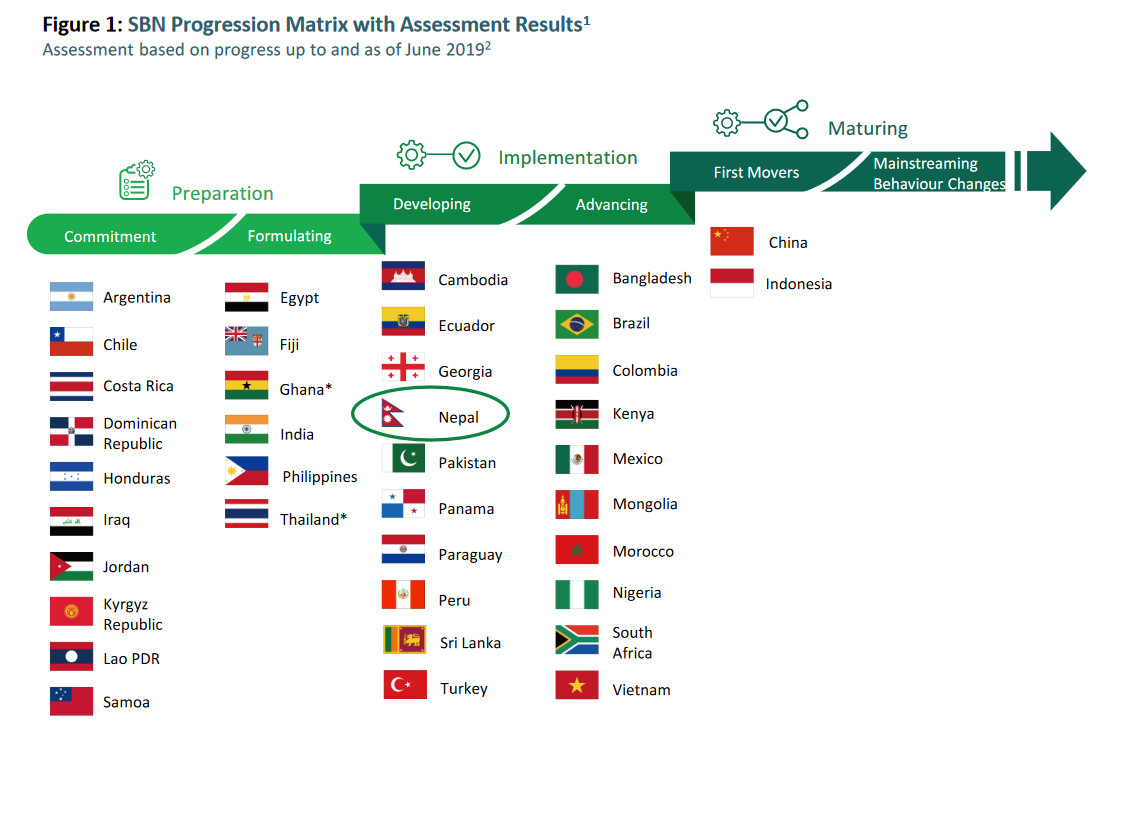
In Nepal, the current development of green finance is largely regulatory driven. At the same time, several Banks and Financial Institutions (BFIs) are also raising ambition by partnering with international institutions and developing green finance instruments. Other than a myriad of national level policies, frameworks and guidelines––such as Nepal’s Nationally Determined Contribution (NDC) to the Paris Agreement––the “Guidelines on Environmental and Social Risk Management for Banks and Financial Institutions (ESRM)” adopted by Nepal Rastra Bank (NRB) in 2018 and the subsequent directives for implementation have been the guiding force behind Nepal’s regulatory driven approach to green finance. According to the Sustainable Banking Network,1 Nepal’s progress is largely regulatory driven and has evolved into the “Implementation Stage” towards a sustainable financial system. As next steps, Nepal is gearing towards the adoption of a national green finance roadmap and the issuance of its first green bond.

A International Finance Corporation (IFC) study from 2017 estimates a total climate-smart investment opportunity of USD 46 billion in Nepal from 2018 to 2030 which can be unlocked through green finance.2 This is in the backdrop of an investment gap which has been estimated between 10-15 percent of GDP annually over the next decade.3 Given the potential of attracting new finance to fill the investment needs estimated, and the importance of such financing to be green, there is an immediate need to realize the progress already made in green financing while assessing existing challenges and gaps before developing strategies, priorities and action plans for the way forward.

Doing so requires an identification and implementation of green finance strategies while acknowledging that the context and national circumstances differ considerably for each country. This is particularly important in Nepal given the baseline portfolio of the country in terms of energy usage is largely green to begin with, which is rather unique when compared to other countries in the region. Nonetheless, the CO VID-19 pandemic provides an opportunity to adopt a green recovery path, with green finance at its core, in transitioning Nepal towards a green and circular economy.

Read the Full Paper below:


DOWNLOAD PDF


Understanding Private Equity and Venture Capital

Deepak Sharma

Investment Director, Business Oxygen (BO2)


Understanding:

Private Equity and Venture Capital (PEVC) is gaining a lot of interest in Nepal and the number of PEVC firms has been growing. PEVC firms provide equity capital, also termed risk capital, to companies that are looking for capital to expand their businesses. Banks provide debts by collecting deposits from people, in the same analogy, PEVC firms provide equity investment to the companies from a pool of funds created from a limited number of investors. Banks provide debt to both entities and individuals while PEVCs provide investment to entities that are already established businesses or are on a path towards it. Private equity invests in more mature companies as venture capital invests in early-stage companies for higher returns.

Structure:

In a PEVC structure, the investors are the Limited Partners (LPs) and the fund managers are the General Partners (GP) of the fund. Funds are an investment pool created with significant commitments from LPs and small commitments from GPs. The role of LPs is limited and are not involved in the day-to-day operation of the fund, they do not take fiduciary risks. It is the responsibility of the GP to manage the fund, which involves deal sourcing, assessing investment proposals, deal structuring, deal negotiation, obtaining required approvals, investment decisions, and providing value-added services including monitoring the portfolio companies and ensuring the exit. It charges management fees to the fund for the fund management services. Traditionally, the 2/20 rule applies – 2% management fee along with 20% participation in profit as carry.

Investment Mandate:

Funds are a commercial finance first model i.e.; funds invest for return from the investment but at the same time they may also focus on the impact creation. Impact doesn’t mean subsidized or low-cost capital, funds may have an environment focus, climate focus, social impact, investments in line with SDGs, and ESG implementation among others. The impact is not a byproduct but a conscious outcome from investments along with the return. Funds have their own mandates and investment policies which define the sector and areas of investment, investment period, fund tenure, size of investment (ticket size), stage of the portfolio company to invest, and other investment criteria. The investment committee (IC) is the governing body of the fund and comprises senior members from the fund management team and independent experts. IC decides on the investment or divestment proposals from the fund manager and ensures that the fund is operated as per the mandate.

Investment Process:

PEVC investments take longer time compared to debt financing; as there is no collateral involved risk is high and the process is stringent. After an application is received thorough review of the financials and business plan is done by the fund manager, a site visit of the premise is conducted, several rounds of meetings are conducted to understand the business, industry, and investment needs, and an independent due diligence is done before final decision is made by the management. The management team then forwards the proposal to the IC which makes the final call.

Differentiator

PEVC investment is equity capital costlier than debt financing but less risky than debt financing. There are no collateral requirements, and no EMIs, and the structure can be customized in each deal in PEVC investment. Technical assistance (TA), network and handholding approach from investment to exit are the differentiators. The success of the fund depends on the success of the portfolio companies. Funds make money when the value of the portfolio company grows and the exit happens at higher multiples. Therefore, funds are equally involved and closely monitor the portfolio companies to help incorporate the best governance, financial, and management practices to prepare for the planned expansion. PEVC firms empower entrepreneurs to operate the business but funds cannot be expected to be involved in daily business operations.

Right capital Mix

Depending upon the existing capital mix, business plan, investment need, stage of the company, risk involved, gestation period, and need for collaboration, an entrepreneur can decide on the type of financing it needs. The right mix of debt and equity investment can provide a sustainable return at lesser risk. One of the fears of entrepreneurs for equity investment is dilution. PEVC funds are close-ended funds which means they have to close after a certain period. Hence, exit is mandatory, entrepreneurs have an opportunity to own 100% of their business at the end of the investment period.


Source : Nepal Private Equity Association (NPEA)


Alternative investments to attract FDI

Photo: BIKRAM RAI/ NEPALI TIMES ARCHIVES

In the past few weeks as Nepal faces trying times with falling growth and high inflation, Kathmandu has witnessed numerous seminars, conferences and workshops with the discourse revolving around the economy and investments.

The consensus that Nepal needs foreign direct investments (FDI) to grow was once again repeated, and the familiar litany of reasons about why it has not been able to. Policy advocates and regulators have understood that the lack of urgency is compounded by procedural inconsistencies and added to the already deficient investment environment in the country.

It is a welcome change from what used to be flippantly accepting things as given that there is now a sense of urgency, with procedural inconsistencies and lack of harmonisation between various Acts and regulations openly discussed.

Furthermore, the desire from government stakeholders to learn and attempt to be part of the solution is also beginning to happen. Whatever policy changes have been introduced in the past have been piecemeal and address the few rather than the entire industry, thus leaving dual regulatory approaches aimed at similar players.

To attract FDI in a competitive global market means Nepal has to demonstrate that it is serious about bringing in investments with a more consultative and collaborative approach with investors. A departure from procedural to a result-oriented focus is needed.

To put issues in perspective, Nepal needs US$20 billion in investments to meet SDG (the UN’s Sustainable Development Goals) targets by 2030. If net-zero decarbonisation targets are to be met by 2045 another US$7 billion will be required annually.

Looking at our investment history and poor government capital expenditure, the gap is long and wide. Last week’s budget showed that in the nine months of this fiscal year, Nepal was able to book a lamentable US$9 million in FDI (equity) investments, a decrease of 98% from the corresponding period last year.

Nepal is in fact the lowest market in South Asia for FDI with 0.3% of the regional average. What is it that we can do to fill the gap?

First: we need to move away from the notion that Nepal only needs large investments. This has proven to be a mistake, and time series data have proven that smaller investments, in aggregate, make a larger impact to economies.

We talk about an ‘enabling environment’ but without the right tools. We place restrictions on interest on debt ceiling (Libor +5.5), without risk premium adjustments, we do not have an active secondary market for bond trading, nor do we have a yield curve, an integral part of the bond market.

In order to attract green financing, Nepal needs to develop its bond market. Billions of dollars of green climate funds are waiting to be tapped. Sovereign risk rating has been mooted, but to be rated in an adverse economic environment could further deteriorate investment potential due to a lesser than expected rating.

Hedging is another instrument that needs further research on. A commercial bank recently showcased the first risk hedging mechanism for an investment of $8 million. This can be the beginning to expand on its modality.

Subordinated debt instruments have been introduced, but on a special nod basis, this now needs to be institutionalised as it is the most applicable form of investments after equity in a market that has volatile forex reserves.

Viability Gap Funding has yet to be implemented and has been in active discussions for a few years now. This needs to come into effect to encourage solar installations in the country.

Moving forward, to attract FDI, Nepal needs to tap into the funds that are available for the growth of small and medium enterprises (SMEs) and climate change. Alternative investments such as Private Equity Venture Capital (PEVC) have been around in a structured manner in Nepal for nearly a decade now. These funds have blended finance components and have attracted climate funding as well.

PEVC is a new asset class and can address the issues of penetrating into SME financing by incorporating environment, social and governance issues into their investment process.  SMEs are the backbone of any economy, PEVC comes with the ability not only to scale up the enterprise with risk capital, but with the ability to bring technical know — how to enhance not only the enterprise, but also the entrepreneur.  A differentiator from all other forms of financing available till date in Nepal.

Blended finance is a way of de-risking investments especially in frontier markets. Business Oxygen (BO2) is an example of blended finance with subordinated debt investments of IFC (World Bank Group) taking the lead and Climate Investment Funds along with FCDO as co-investors.

On a larger scale, the 216MW Upper Trisuli1 is another example of blended finance with IFC, a Korean consortium and local investments.  So far, we see that development finance Institutions have been taking the lead in Nepal as their risk appetite is greater than commercial investors and they are eager to help develop the financial markets.

In order to be sustainable, we need to step on this and attract commercial capital from all over the world. To do this there has to be political will to make that pivot.

The recent budget has tried to address some issues in a cosmetic manner, and once again it lacks the overall approach to the problem.  Nepal has outdone many countries in its macro-economic indicators, with sound forex reserves and a stellar history of debt payments to its creditors. This story needs to be propagated along with the drive for change to attract potential investors.


Siddhant Raj Pandey
writer
Siddhant Pandey is CEO of Business Oxygen (BO2).


Green is the colour of money and nature

In March, the World Bank approved a $150 million ‘Finance for Growth’ credit line to strengthen Nepal’s financial sector for green, resilient, and inclusive development. However, critics say lack of money has never been the issue for the country to make a transition to renewable energy, it is the dearth of political will.

The Finance for Growth loan package kicks off a new climate agenda for Nepal by promoting climate finance resilience policies in banking, insurance, and capital markets, which lay the groundwork for the adoption of green loan incentives and new insurance and capital market products that are tailored to meet climate challenges.

It also hopes to improve supervision of the banking sector to address financial stability risks in the context of the pandemic, foster financial product innovations through opening up capital, insurance, and disaster risk financing markets, and increase liquidity and inclusion through access to external commercial borrowing, financial literacy, and financial digitalisation.

“This credit creates a strong foundation for a more stable, less bank-centric and more inclusive financial sector that is better positioned to mobilise private investment and support real economic activity,” says Peter Mousley, the World Bank task team leader for the project.

Indeed, green banks have the potential to reduce financing risks, finance underserved markets, attract foreign investment, fulfill national renewable energy targets, and help to fulfill carbon reduction commitments. But to fully tap into the potential of green financing, both public and private sectors will have to make efforts.

Nepal Rastra Bank (NRB) has been the key driver behind spurring sustainable finance in the country. In a recent report by the IFC-facilitated Sustainable Banking Network (SBN) titled Necessary Ambition: How Low-Income Countries Are Adopting Sustainable Finance to Address Poverty, Climate Change, and Other Urgent Challenges, green finance has been identified as a top priority in Nepal’s financial sector.

NRB launched the first policy document in 2018 Guideline on Environmental and Social Risk Management (ESRM) for Banks and Financial Institutions . which marked Nepal’s sustainable finance policy implementation, which has since progressed from ‘formulating’ under the ‘preparation’ stage to ‘developing’ under the ‘implementation’ stage (See chart). 

Source: 2019 Country (Nepal) Progress Report of SBN, Addendum to SBN Global Progress Report.

In 2020, NRB issued a Unified Directive to require all banks and financial institutions to integrate environmental and social risk management into their overall credit risk management process as well as policymaking.

Furthermore, the Netherlands Development Finance Company (FMO), has been collaborating with NMB Bank to work in renewable energy, hydropower, and green project financing. It is providing loans and equity investment for the Environmental and Social Management System (ESMS), and by doing so it will likely invite more equity investments in small and medium enterprises (SME).

Moreover, by providing credit to SME clients instead of big corporations, FMO supports equity investments in private equity funds such as Dolma Impact Fund I and II. Companies such as Nepal Invests aim to attract more capital from Development Finance Institution (DFI) to the Nepal financial system. However, to be eligible for loans by DFIs, ESMS is often a prerequisite. Nepal Invests is helping other banks to meet that necessary condition.

SMEs have been a crucial player in Nepal’s growth, making up about 20% of GDP and accounting for over 60% of employment opportunities in the country. In 2020, IFC provided a $25 million loan to NMB to help finance green projects and SMEs. This investment will expand NMB’s SME portfolio to over $1 billion by 2025 and generate 50,000 more jobs. The quantity of loans available to SMEs from NMB is expected to double as a result of the project.

“The chances of receiving funding will be exponential if SMEs are in sync with international best practices such as environmental, social and governance measures, we have demonstrated that risk capital can help mitigate climate change,” says says Siddhant Raj Pandey, CEO of Business Oxygen (Bo2), Nepal’s first international Private Equity Impact and Climate Related Fund. “To have an inclusive model, climate-smart approaches and transparent operations are critical to the success of companies.”

The critical next step for Nepal’s green finance will be expanding the adoption of the Environmental and Social Risk Management (ESRM) Guideline to other banks across the country. Building the capacity of regulators and financial institutions, strengthening implementation coordination, and developing a taxonomy of green and socially inclusive initiatives are among the central bank’s top priorities. These would provide a favorable and enabling environment for sustainable finance and open up green finance projects.

But for the private sector to invest in renewables and include green finance in their agenda, the government needs to provide them with incentives. For example, the other renewable energy sectors should get the same favorable treatment such as tax breaks much like hydropower. Private players such as Multilateral Development Banks (MDBs), industry associations, and local financial institutions can tap into the field.

Green banking has got a strong start in the public sector, but private parties are lagging behind and they should get on board to secure a better and safer financial system. Since private equity and venture capital are still relatively new concepts in Nepal, the role of the Nepal Private Equity Association (NPEA) become crucial in providing the ecosystem for a lobbying platform.

Business Oxygen, a climate-focused fund with investments from the IFC, Climate Investment Funds, and the FCDO, has been investing in and promoting climate-smart approaches. The firm measures investment’s success not only through impact numbers on the financial statements but also metrics in accordance with the UN’s Sustainable Development Goals.

It has a separate fund dedicated to providing technical support to companies whose financials are not able to comply with environmental, social and governance measures. ESG compliance monitoring is essential to the investment decision-making process. “Impact is an intentionality of our investment not just a by-product,” says Pandey of Bo2.

However, as a foreign direct investment (FDI) company, there are many policy and regulation challenges. Early on, Bo2 had a good pipeline of companies in the agricultural sector, but they were discontinued due to the Foreign Investment and Technology Transfer Act (FITTA) which prohibited FDI investment in agriculture. Later, the government raised the investment threshold limit from Rs5 million to Rs50 million which forced SME investors to diversify their strategies.

One area where Nepal is continuously and successfully bringing in investment is the green hydro project with experience of over 20 years. Investor trust is built upon sufficient human resources and a proper supply chain of equipment including turbines and hydro, mechanical and electromechanical machinery required.

“Even very risky hydro projects can still receive 70% of debt financing from local banks here in Nepal,” says Kushal Gurung, CEO of Windpower Nepal, adding that hydro projects are easily financed under an established ecosystem and intact supply chain.

But this is not the case for other green projects such as wind and solar where debt financing remains a challenge. The lack of trust from banks stems from a much shorter track record and low confidence in the revenue model.

But the good news is that such green projects need much lower investment. This allows private investors to come in and provide equity financing. “A solar project can be entirely financed by private equity investment with zero debt financing unlike hydropower where the opposite is true,” adds Gurung.

The climate crisis has added to problems like water availability, spatial-temporal distribution, and alteration in the hydrological cycle have been altered. Last year, Nepal’s electricity generation declined by 6.9% and this is expected to get worse, especially in the dry season. Nepal’s 15th Five Year Plan (2019-2024) has set a key target to achieve a 12% share of renewable energy in overall energy consumption. In 2022, it is a mere 3.27%.

An energy resilient Nepal needs effective collaboration between public and private entities. Public financing is insufficient but by greening the system with government subsidies, will save both the ecology and economy.

Angel Li is a student at Pitzer College in California.

Nepal’s potential for blended finance: A country-level study

Southern Voice is a network of 50+ think tanks from Africa, Asia and Latin America. Since its inception in 2012, it has served as an open platform. It provides structured inputs from the Global South into the debates on the 2030 Agenda, and the SDGs, with a view to addressing the ‘knowledge asymmetry’ and ‘participation deficit’ that usually afflict such global discussions.


Download Article PDF